Women’s Contributions to Lithuania’s Civic and Political Development
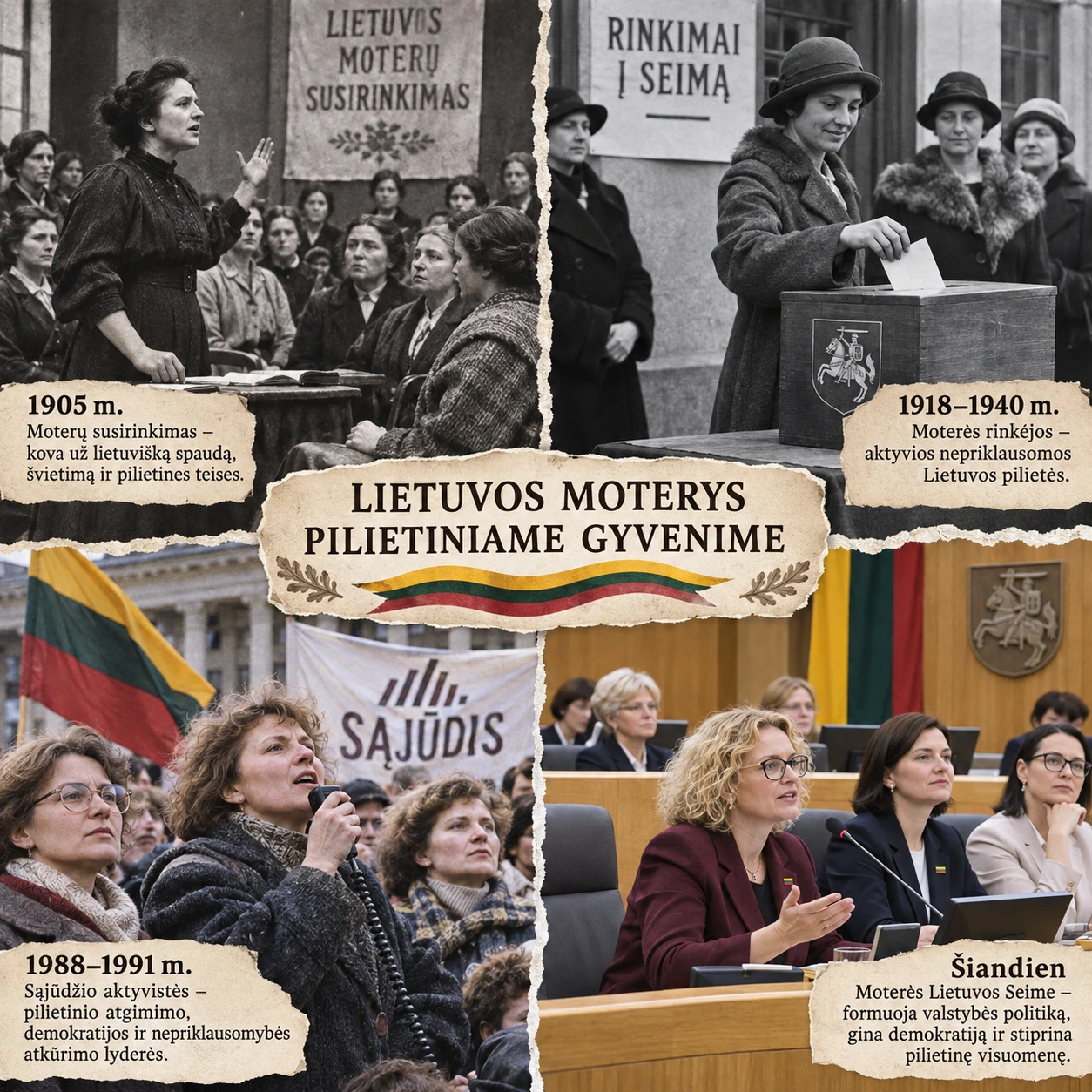
Women have helped shape Lithuania’s public life as educators, organizers, writers, activists, voters, and political leaders. Their influence has taken different forms across the national revival, the First Republic, Soviet-era Lithuania, and the restoration of independence in 1990. Formal representation has never told the whole story: women often built civic networks and sustained public action even when political power was restricted.
Before independence: women enter public and civic life
Before Lithuania became an independent state, women expanded civic life through education, publishing, cultural work, and political organizing. These activities helped turn demands for women’s rights and national self-determination into visible public concerns.
In the late nineteenth century, Lithuanian national revival took place under the Russian Empire, where Lithuanian-language publications faced restrictions. Women contributed as writers, teachers, and supporters of cultural education, helping preserve the language and widen access to knowledge. Public influence often began outside formal politics, through schools, reading circles, charitable work, and the circulation of ideas.
The 1905 Great Seimas of Vilnius brought national and democratic demands into sharper public focus. Women participated in the wider movement for political change, while women’s organizations increasingly articulated claims about education, social reform, and political participation. In 1907, the first Lithuanian women’s congress in Vilnius gave these discussions an organized platform. Activists did not all share the same priorities, but their work established women as participants in debates about the nation’s future, rather than merely subjects of reform.
For an overview of the legal history of suffrage, see the Seimas of the Republic of Lithuania, which provides institutional information about Lithuania’s parliament and constitutional history.
Women in the First Republic
After Lithuania declared independence in 1918, women gained formal political rights and entered the institutions of the new republic. The 1918 provisional constitution recognized women’s equal political rights, including the right to vote and stand for election.
Women voted in the 1920 elections to the Constituent Assembly, which shaped the country’s constitutional and legislative foundations. Women also won seats in that assembly, including figures such as Gabrielė Petkevičaitė-Bitė, a writer and public activist who served as its first chairwoman during its opening session. The presence of women in the assembly was significant, though it did not mean that political power was evenly shared. Women remained a small minority among elected representatives.
In the interwar years, women took part in parties, professional associations, education, journalism, and women’s civic organizations. Groups such as the Lithuanian Catholic Women’s Organization combined social service with public engagement, while other women promoted education, labor rights, and secular civic activity. Their work reflected different religious, ideological, and class interests. This variety matters: “women’s participation” was not one unified program, and gains in legal equality coexisted with limits in employment, social expectations, and access to leadership.
Civic life under Soviet rule
Under Soviet rule, women participated widely in work, education, culture, and community life, but independent political organizing was tightly constrained. The state promoted women’s employment and education while restricting pluralism, free association, and opposition to Communist Party authority.
Women worked in factories, schools, health care, research, and public administration, and many contributed to cultural institutions and local community networks. These roles could bring professional expertise and public responsibility. Yet official equality did not guarantee equal influence: senior political decision-making remained controlled by the party-state, and civic organizations generally operated within approved structures.
Some women maintained religious, cultural, or national traditions in private and semi-public settings, while others challenged Soviet control through dissident activity. Their choices varied with occupation, location, family circumstances, and personal risk. It is misleading to describe the period either as one of full emancipation or as a complete absence of women’s agency. Soviet policies opened some educational and professional paths, but they narrowed the space for independent civic action and political choice.
Women in the independence movement
Women contributed to Sąjūdis and Lithuania’s restoration of independence by organizing meetings, sharing information, joining demonstrations, and sustaining civic networks. Their participation helped make the independence movement a broad social mobilization rather than a project confined to political leaders.
Founded in 1988, Sąjūdis brought together people seeking political reform, national sovereignty, and greater openness. Women took part as activists, intellectuals, cultural workers, journalists, and supporters. They helped arrange gatherings, distribute materials, and connect local communities to national events. Women also participated in the mass demonstrations and public actions that challenged Soviet authority.
The Baltic Way of 23 August 1989, when people formed a human chain across Lithuania, Latvia, and Estonia, illustrated the scale of civic participation. Women were among those who organized and joined such actions, although accounts of the movement often place its most visible male leaders at the center. That difference between participation and public recognition remains important when assessing historical influence.
On 11 March 1990, Lithuania’s Supreme Council declared the restoration of independence. Women’s activism did not by itself determine the political outcome, but it strengthened the public legitimacy and civic reach of the independence movement. The transition also created new challenges: the skills developed in mass mobilization did not automatically translate into equal representation in the institutions that followed.
From independence to political representation
Since independence, Lithuanian women have served in the Seimas, political parties, government, public institutions, and civil society. Their representation has expanded in some periods, but it has remained uneven and shaped by party structures, electoral competition, and broader social expectations.
The Seimas is Lithuania’s unicameral parliament, where elected members debate and pass laws. Women have served as MPs, ministers, committee leaders, and senior public officials. Kazimira Prunskienė became Lithuania’s first post-independence prime minister in 1990, leading the government during a difficult transition marked by economic pressure and Soviet opposition. Her appointment demonstrated that women could hold the highest executive office, though one appointment could not resolve wider barriers to political advancement.
Women have also influenced policy and public debate through nongovernmental organizations, trade unions, professional associations, local government, and advocacy groups. These organizations address issues such as family policy, education, labor conditions, domestic violence, and equal opportunity. Civic work can shape legislation and public priorities even when its participants do not hold elected office.
Representation should be assessed in more than one way. The number of women elected matters, but so do their roles in party leadership, committee assignments, executive decisions, and civil society. A parliament may include women without giving them equal access to influential portfolios; conversely, local advocacy can produce concrete change without high-profile national office.
Continuing influence and challenges
Women’s contributions remain central to Lithuania’s democratic development, while equal participation in political power is still an ongoing question. A fuller account recognizes both formal achievements and the less visible civic work that sustains public life.
Lithuania’s history shows several routes to influence: building cultural institutions, securing voting rights, working within public services, joining independence movements, serving in elected office, and organizing through civil society. Each route has depended on its era’s laws and political conditions. Progress has not been steady, and democratic rights on paper do not remove barriers such as unequal care responsibilities, limited access to party networks, or public scrutiny that falls differently on women politicians.
It is also important to avoid treating Lithuanian women as a single group. Their experiences have differed by generation, region, ethnicity, class, profession, and political belief. Including those differences makes the history more accurate and clarifies why representation alone cannot measure civic influence. The continuing task is to ensure that women can participate, lead, and shape decisions across institutions, not only appear in moments of national crisis.
Frequently asked questions
When did women gain the right to vote in Lithuania?
Women gained voting rights with the establishment of independent Lithuania in 1918. They voted in the 1920 elections to the Constituent Assembly and could stand for election under the new state’s political framework.
How did women contribute to Lithuania’s independence movement?
Women in Sąjūdis and the wider independence movement organized meetings, circulated information, joined demonstrations, and built local civic connections. Their participation helped broaden public support for the restoration of independence in 1990.
What roles do women hold in Lithuanian politics today?
Women serve as members of the Seimas, ministers, local representatives, party officials, public administrators, and civil society leaders. The range of roles is broad, though the balance of representation and access to decision-making positions can vary over time.