Analyzing the Influence of the Baltic Way on Global Peaceful Protests
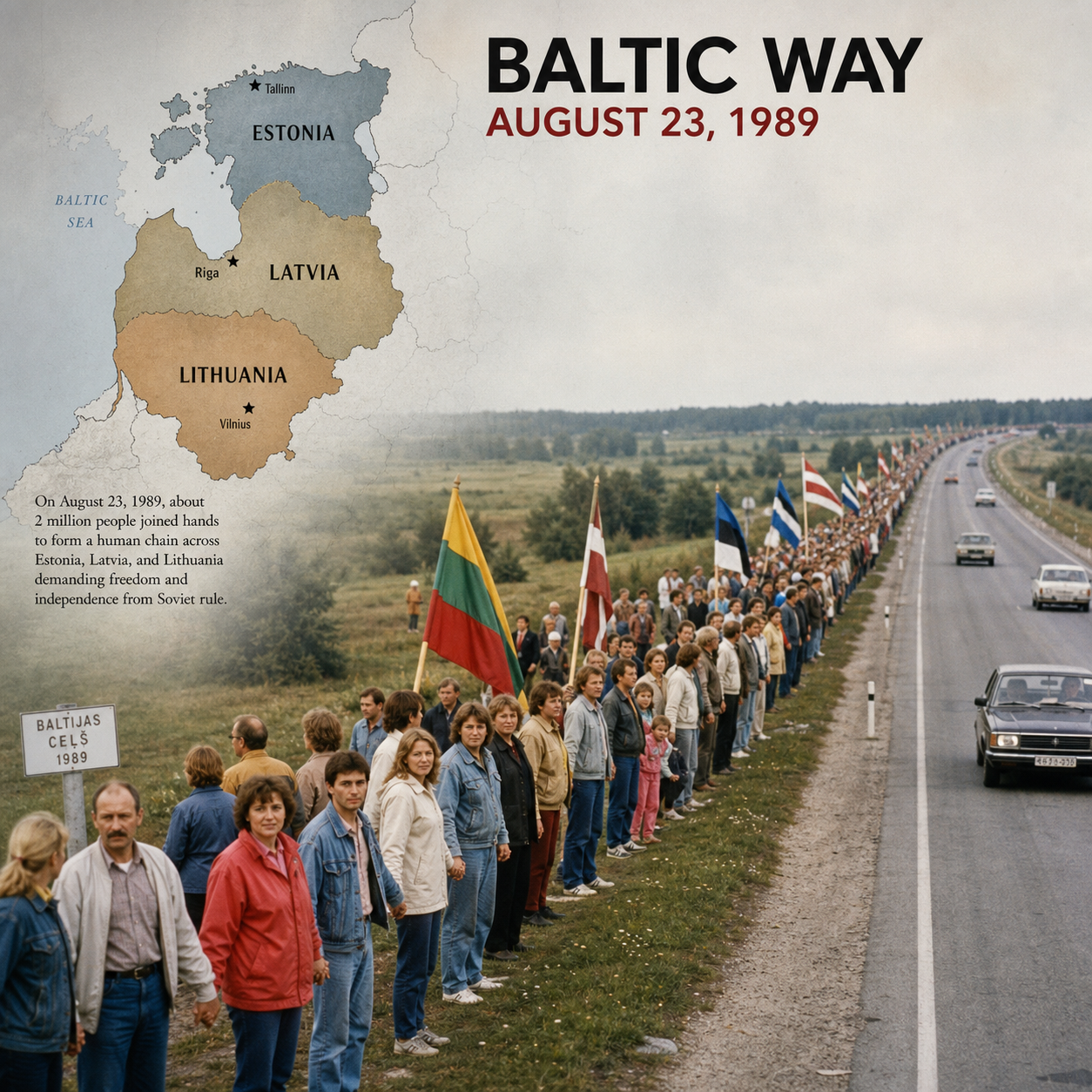
The Baltic Way was one of the most striking acts of peaceful protest in late twentieth-century Europe. On 23 August 1989, roughly two million people joined hands across Estonia, Latvia, and Lithuania, creating a human chain that stretched about 600 kilometers from Tallinn through Riga to Vilnius. The action demanded recognition of Baltic sovereignty and exposed the continuing political consequences of the Soviet occupation.
Its importance reaches beyond the history of the Soviet Union. The Baltic Way showed how historical memory, disciplined nonviolent resistance, and carefully designed public symbolism could turn a political grievance into a visible civic mandate. Later peaceful protest movements did not all copy it directly, but many used related ideas: mass participation, shared symbols, strategic public space, and international communication.
What Was the Baltic Way?
The Baltic Way was a coordinated human chain across Estonia, Latvia, and Lithuania on 23 August 1989. It marked the fiftieth anniversary of the Molotov–Ribbentrop Pact and called attention to the pact’s secret protocol, which had divided parts of Eastern Europe into Nazi German and Soviet spheres of influence.
The protest emerged during the broader Singing Revolution, a period when large numbers of Estonians, Latvians, and Lithuanians used songs, public gatherings, cultural expression, and political organization to challenge Soviet rule. The Baltic national movements, including the Popular Fronts of Estonia, Latvia, and Lithuania, helped coordinate the event across national borders.
Participants stood along roads, in towns, and in rural areas. At a designated moment, they joined hands, creating a continuous line that represented solidarity among three nations. The gesture was simple enough for families, workers, students, and older people to join, yet powerful enough to be understood by domestic audiences, Soviet authorities, and international observers.
The political objectives were precise. Protesters sought acknowledgment that the Baltic states had been illegally incorporated into the Soviet Union, affirmed their right to national self-determination, and demanded a path toward restored independence. The action also challenged the official Soviet version of history, which had long minimized or denied the significance of the Molotov–Ribbentrop Pact’s secret arrangements.
UNESCO later recognized the Baltic Way documentation in its Memory of the World Register, reflecting the event’s historical and documentary importance.
How the Baltic Way Turned History into Collective Action
The Baltic Way transformed a disputed historical event into a shared, organized act of civic participation. By linking the Molotov–Ribbentrop Pact to lived national experience, organizers made history politically relevant in the present.
Historical memory served as the movement’s organizing language. The pact was signed in 1939, but its consequences remained visible in restrictions on political freedom, cultural control, demographic change, and the loss of state independence. Remembering the pact therefore did more than commemorate the past. It established a legal and moral argument: if the incorporation of the Baltic states resulted from an unlawful secret agreement, then independence could be framed as restoration rather than secession.
That framing helped connect different groups. A person did not need to belong to a political party or understand every detail of Soviet constitutional law to grasp the basic claim. The shared chain made national identity tangible while also presenting Estonia, Latvia, and Lithuania as partners in a common struggle.
The event’s cross-border design mattered. Separate demonstrations could have expressed three national grievances. A single human chain expressed a regional coalition. That distinction strengthened the message to international audiences and reduced the impression that the protest was an isolated local disturbance.
Organizers also had to solve practical problems: determining the route, communicating timing, directing participants to gaps, preparing local committees, and maintaining calm. The result was a form of political participation that combined emotional memory with logistical discipline.
The Protest Methods Behind Its Impact
The Baltic Way gained influence through a combination of nonviolence, mass participation, visual symbolism, and coordinated communication. Each method reinforced the others, turning a peaceful gathering into a credible political demonstration.
Nonviolent resistance
The action denied authorities an easy justification for violent repression. Participants stood, held hands, sang, and demonstrated without attacking people or property. This discipline communicated confidence and helped preserve broad public participation.
Nonviolent resistance does not mean passivity. The Baltic Way interrupted official narratives, occupied public attention, and created political costs for authorities that might respond with force. Its effectiveness depended on preparation and restraint, not simply on the absence of violence.
Mass participation and accessibility
A human chain required no specialized equipment and offered a clear role to almost everyone. People could join for a short period, bring relatives, or participate through local gathering points. This low barrier to entry helped convert political support into visible numbers.
Numbers alone do not guarantee political change. However, mass participation can alter perceptions of legitimacy. It signals that opposition is broad, organized, and socially rooted rather than limited to a small dissident circle.
Symbolic public space
The road became a political stage. By occupying a route that connected three capitals and many communities, protesters mapped their political claim onto the landscape. The physical line represented continuity, connection, and collective will.
The image was especially effective because it could be understood quickly in photographs and television reports. The Baltic Way became a form of visual communication before social media made such imagery routine.
Communication networks
Local committees, civic organizations, churches, cultural groups, and informal personal networks helped circulate instructions. Organizers used printed materials, word of mouth, radio, and existing political structures. The protest therefore relied on both modern communication and trusted community relationships.
Its core tactical formula can be summarized as memory, bodies, message: historical memory supplied the claim, human bodies made the claim visible, and a concise message made it legible to outsiders.
Influence on Later Peaceful Protest Movements
The Baltic Way influenced later peaceful protests mainly as a repertoire of ideas rather than as a single copied blueprint. Its strongest contribution was demonstrating how unity, symbolism, and civic discipline could communicate political legitimacy.
Movements in different countries have used comparable tactics: forming human chains, gathering in highly visible public places, carrying shared colors or signs, and linking local actions into a national or international event. These similarities do not prove direct organizational influence. Protest movements often develop similar methods independently because the tactics are understandable, inexpensive, and visually powerful.
The Baltic Way also offered a model for connecting domestic action with international advocacy. Organizers understood that the protest had two audiences. At home, it strengthened solidarity and participation. Abroad, it challenged foreign governments, journalists, and international institutions to treat Baltic independence as a serious political issue.
Its influence is best assessed through five comparisons:
- Goal: The Baltic Way pursued national self-determination and restoration of statehood, while other movements may seek elections, civil rights, peace, or policy reform.
- Tactic: The human chain created a nonviolent public demonstration, but later campaigns may rely more heavily on strikes, boycotts, sit-ins, or digital coordination.
- Symbolism: The linked bodies represented unity across borders; other movements use flags, clothing, songs, memorials, or occupation of civic landmarks.
- Participation: The Baltic action depended on a broad social coalition, a condition that cannot be assumed in every political system.
- Result: The Baltic Way contributed to a wider independence process, but its success also depended on changing Soviet politics, institutional organization, and subsequent negotiations.
These distinctions prevent a common analytical mistake: treating resemblance as proof of direct causation. The Baltic Way can inspire, provide a precedent, or enter a movement’s symbolic vocabulary without determining its strategy or outcome.
Limits of the Baltic Way as a Global Model
The Baltic Way is a powerful example, but its tactics cannot be transferred unchanged to every political context. Political institutions, media access, public safety, cultural identity, and movement objectives shape whether a human chain or similar spectacle will work.
In 1989, the Baltic movements operated during a period of Soviet reform and growing political uncertainty. Mikhail Gorbachev’s policies had widened public debate, even though repression and censorship remained real threats. The international environment also mattered: global audiences were increasingly attentive to democratic change in Eastern Europe.
Other movements may face a government that controls all media, blocks roads, disables communications, or uses mass detention. A highly visible gathering can then expose participants to severe risk without producing comparable political pressure. Choosing a public spectacle for visibility may mean accepting greater vulnerability.
Cultural context matters as well. The Baltic Way drew strength from shared historical memory and relationships among three neighboring nations. A movement lacking a broadly accepted narrative may struggle to create the same emotional coherence. Conversely, emphasizing national identity can exclude minorities or make a campaign appear hostile to pluralism.
There is also a strategic limit. Symbolic unity can open political space, but it rarely substitutes for sustained organization. Movements need negotiators, legal advocates, independent media, community structures, and plans for the period after the demonstration. The Baltic Way was effective partly because it formed one event within a broader campaign rather than standing alone.
Why the Baltic Way Still Matters
The Baltic Way still matters because it connects human rights, democratic legitimacy, and national self-determination through peaceful civic action. It shows how a population can contest official history without abandoning nonviolent methods.
For students of peaceful protest movements, the event offers a useful analytical framework. Ask three questions: what shared memory gives the movement meaning, what physical action makes participation visible, and what political channel can convert visibility into change? The Baltic Way answered these questions through the Molotov–Ribbentrop Pact, the human chain, and coordinated national independence movements.
It also complicates the idea that nonviolent resistance succeeds through moral appeal alone. The protest was morally compelling, but it was also carefully organized. Participants created a public fact that authorities could neither easily dismiss nor explain away. That combination of ethics and strategy remains central to modern civic action.
For contemporary movements, the lesson is not to recreate the exact scene. It is to adapt the underlying principles: make the claim historically intelligible, design participation for ordinary people, choose symbols that communicate across audiences, protect nonviolent discipline, and connect a single event to longer-term institutions.
The Baltic Way therefore belongs in both civic history and the study of global peace activism. Its legacy lies less in a direct chain of influence than in a durable demonstration of what coordinated citizens can make visible: a shared past, a present demand, and a possible democratic future.
Frequently Asked Questions
What was the main purpose of the Baltic Way?
The main purpose was to protest the consequences of the Molotov–Ribbentrop Pact, challenge Soviet rule, and support the restoration of independence for Estonia, Latvia, and Lithuania.
How did the Baltic Way demonstrate nonviolent resistance?
Participants used a disciplined human chain, public assembly, songs, and peaceful political messaging rather than violence or attacks. The action created pressure through participation, visibility, and international attention.
Did the Baltic Way directly influence later global protests?
In some cases, it may have provided inspiration or a recognizable example, but direct influence should be demonstrated rather than assumed. Many later movements independently adopted similar tactics because human chains and mass gatherings are accessible and visually clear.
What lessons can modern civic movements learn from it?
Modern movements can learn to connect historical memory with a specific political goal, lower barriers to participation, use public space strategically, communicate with domestic and international audiences, and treat peaceful discipline as an organized method rather than a spontaneous mood.